The great amplifier

The great amplifier

Appreciation happens when you add value to an asset. We learned all about that in the previous section.

Leverage amplifies gains and losses.

Let's talk about gains first.

The basic principle is that you realize appreciation not only on the cash you put into the deal (25%) but also the cash the bank put into the deal (75%).


On a property worth $1MM let's do some math here. Let's assume appreciation over time at 5% per year for the first 5 years of ownership.

That means the property appreciates by $50k the first year and then 5% every year thereafter.


Your equity over time:


The bank loaned you the money to buy the asset but they don’t realize any appreciation, you just need to pay them back with interest. BUT THE ENTIRE ASSET GROWS.


Even at a 2.5% inflation, this is what it looks like:



You’ve added over $150k to your $250k investment in 5 years.


Now an important note here:

This may work automatically for residential houses in growing cities, but remember that commercial real estate is valued based on NOI and not rising costs of living.


So how do we raise net operating income and make our property more valuable? 

The answer is to raise revenue slowly over time to the point that it out-paces expenses. In self-storage, we raise rents on current tenants 6% every 9 months. We also see a 3-5% annual street rate increase (or more if we are in a market without much supply). 

That, evened out, generally means we can grow revenue by 4-6% each and every year even after we are stabilized (already full of tenants).


This is when we need to talk about CAGR.

“Compounding Annual Growth Rate”. How much is each lever in this massive equation changing in a given year?


If your expenses grow at 3% and you can increase your revenues at 4% per year, which we try to do in the self-storage business, this is what happens to the value of your equity in the asset over time:
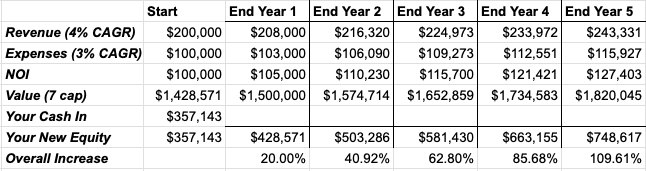


Since your equity is only 25% of the overall pie, and the revenue is already 2x as large as the expenses / assuming a 50% expense ratio here (self-storage is even lower of an expense ratio and these levers are even more powerful), your equity more than doubles in a 5 year period.


This is not a value add deal, it is simply a fully stabilized property chugging along and letting father time work its sweet sweet magic.

And this, my friend, is why I never like to sell real estate. Because over the course of 5 years you can double your amount of equity in a deal just by tugging on a few levers and being a good operator.


But wait, there is more! (I feel like Billy Mays selling magic cleaner)

If we have a 25-year amortization schedule and a 4% interest rate we pay back some debt each year as well. The payment stays the same but you pay off MORE debt each year. The interest amount goes down and the principal amount goes up.

Run an amortization calculator on https://www.amortization-calc.com/mortgage-refinance-calculator/ and you’ll see the magic.


It is like a forced savings account. Yes, it sucks your cash flow, but you are slowly building more equity every single month.


In this example, with a 75% LTV loan at 4% on a 25 year am, we have added back the debt pay-down to your equity number, along with the 4% growth in revenue and 3% growth in expenses:
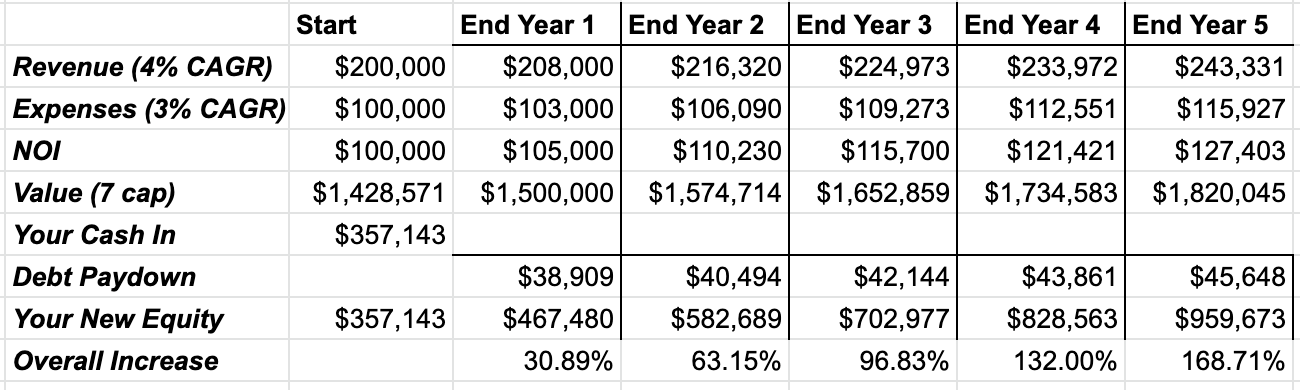

Your initial $357k in equity (your cash into this deal) has turned into $959k. 

How about that for long-term wealth building?


And this isn’t even taking into account cash flow! Let's see how it looks when we model out our cash flow and get a feel for our overall position on this investment.


Powerful, powerful stuff.

So now what? Do we sell? Let's talk about our options in the next section.


Note: Leverage can amplify losses just as easily as it can amplify gains. We'll cover the risks in greater detail in the "risks" section.

Nick's Real Estate Masterclass

Buy nowLearn more

Introduction

  • Who is this course for?
  • How do real estate investors get really wealthy?1
  • The two almighty definitions: NOI and Cap rates2
  • Cap rates and NOI - a quiz
  • Quiz Review
  • Nick's Journey1
  • Nick's Portfolio (Recorded December 2021)
  • Nick's Portfolio (Recorded March 2022)1
  • A note

Feedback and Comments

  • Before you dive in

How to create a lot of money out of thin air

  • The wealthiest guy I know1
  • Trampolines, gyms and cold hard cash

The skills you need to win

  • Sales3
  • Communication and Writing1
  • Resourcefulness
  • Likability, Trust and Emotional Intelligence

Types of real estate

  • A list of niche real estate asset classes and key terms

The mindset of a successful investor

  • The way to think about the critical aspects of business1

How to learn any asset class very quickly

  • Find the professionals - talk to them, work for them or compete with them

How real estate is valued

  • Smell Tests, speculation and trends
  • Underwriting - how to figure out what a property is worth to you4
  • Aspects of a good cash flow model2
  • Deal Overview4
  • Monthly Cash Flow Model1
  • A walk through of my model1
  • Where do you get a model specific to your industry?
  • Due Diligence
  • Due Diligence List

Appreciation

  • How appreciation works3
  • The ways to force appreciation
  • An operational advantage and the holy grail
  • The roll-up strategy and cap rate compression
  • Time - the ultimate tailwind

Leverage

  • Leverage Basics
  • Key definitions
  • The great amplifier4
  • Visualizing Leverage in Real Estate w/ Nick Huber
  • Refinance and Recaps
  • Deal Breakdown: My $2MM cash-out-refi3
  • Debt Constant
  • Debt Constant Worksheet
  • Debt Constant Quiz Review
  • Debt Yield2
  • Debt Constant Table
  • Debt Constant / Debt Yield discussion1
  • Debt Constant / Debt Yield Quiz
  • Quiz Review
  • Alternative financing method: securities backed line of credit
  • Negative Leverage - Explained

Test your knowledge - managing risk

  • Model Walkthrough - Stress Tests
  • Stress Tests - Excel.xlsx
  • Managing Risk - Quiz
  • Quiz Review

Update

  • What do you think so far?10

The Tax Advantages of Real Estate

  • Depreciation / Bonus Depreciation
  • Basis, Bonus Depreciation, Recapture, Capital Gains1
  • Interest Expense as a Deduction
  • Real Estate Professional Status1
  • 1031 Exchange2
  • Step-up In Basis
  • Income vs. Capital Gains
  • QOZ - Qualified Opportunity Zone
  • Conservation Easements
  • Additional Loopholes
  • Basis and Depreciation Quiz
  • Recapture and Capital Gains Quiz
  • IRS Publication 946 - Depreciation
  • IRS Depreciation FAQ
  • Cost Seg Study Example - Self Storage Facility
  • Cost Seg Study Example - Vacation / rental property

The Risks of Real Estate

  • How to lose a lot of money really fast
  • Everything is cyclical1
  • Operations, Emotions and CAPEX
  • How to hedge your risk

How do I get started?

  • What you probably don't want to hear
  • Quality over quantity
  • The golden rule of real estate
  • How much cash do I need and what kind of returns can I expect?
  • Scale or stay small?
  • Beta vs. Alpha
  • My framework for spotting real estate opportunities
  • Real estate opportunities I love right now

Your real estate team

  • The Banker, Attorney, CPA, Contractor and Insurance Agent
  • The hardest relationship to build - contractors and service providers

The dynamics of buying a property

  • Are you a closer or a joker?
  • The off-market cold call
  • Looking at deals from Brokers
  • The offer
  • DEAL OVERVIEW: Gloversville - when the buyer has all the leverage1
  • LOI - GLOVERSVILLE SIDE BY SIDE (4).pdf
  • PSA, Real Estate Attorney, Due Diligence Period
  • Due Diligence Request List.pdf

Raising OPM (other people's money)

  • A day in the life - trying to finish raising for a deal
  • Raising Other People's Money
  • Sources of Outside Capital
  • When should I get LPs? Should I raise money on my very first deal?
  • Selling Limited Partners on your Deal
  • Communicating and Reporting
  • Company Overview Deck
  • Preferred Equity Deck Example
  • 2020 Year in Review - Bolt Storage
  • 2021 Year in Review, Bolt Storage

How to dominate Twitter

  • How I raised $5MM in capital on Twitter
  • How to go from 95 followers to 95,000 followers in 10 months
  • The bad news

Deal Structures

  • The real estate private equity terminology you need to know
  • How real estate private equity works
  • Terms
  • Prefs, Promotes, Waterfalls2
  • Fees
  • How to think about fees
  • How should you structure your deal?
  • PPM and Executive Summaries
  • Elmira NY Investment Prospectus
  • Accredited Investors
  • The straight split structure
  • My process with LPs1
  • Vetting LPs and Managing Expectations
  • Re-capitalizing a Deal
  • Ohio Portfolio Executive Summary.pdf
  • FINAL LP Expected Case Akron Bowling Green Wolf.xlsx
  • Bolt Track Record.xlsx
  • Peru, IN Storage Portfolio Executive Summary.pdf
  • Georgia Portfolio Executive Summary.pdf
  • How to think about building a sustainable private equity company
  • How my real estate private equity and management company work together

How to scale your portfolio

  • The Method
  • Building your team
  • Finding off-market deals
  • Deal-flow from brokers
  • The ability to close "messy deals"

Investing with others as a Limited Partner

  • What questions should I ask?
  • New York Self Storage Investor Deck
  • New York Self Storage - Nick's Thoughts1

My biggest mistakes in real estate

  • New development, zoning and prepayment penalties

Nick's Deal Breakdowns and Additional Resources

  • My first deal and how we made $2MM through a cash-out refinance1
  • Pittsburgh PA Deal
  • Shippenville PA Deal
  • Closing on Erie / Pittsburg (vlog style)
  • Deal Breakdown - Gloversville (2021 Update)
  • RE #73: Nick Huber - Self Storage & Sweaty Businesses
  • RE #112: Nick Huber - Self Storage, Twitter, & Sweat (Part 2)
  • Profitable Real Estate Investing I Nick Huber l Pomp Podcast #453
  • Get to know Nick - and the non-sexy areas of entrepreneurship
  • Nick's Booklist
  • How profitable is a storage facility? Nick's 2021 Deal Breakdown
  • Nick's Talk at Re-Convene1
  • Deal Breakdown - Tompkins County NY

The case for buy-and-hold real estate

  • Parting thoughts